
- News
- City News
- Hyderabad News
- Drug-driving: A new menace on road, police in deep abyss
Trending
This story is from September 21, 2018
Drug-driving: A new menace on road, police in deep abyss
No Device To Catch Addicts, Police Rely On Appearance
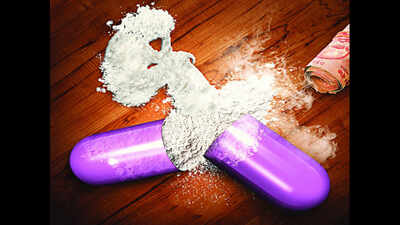
Picture used for representational purpose only
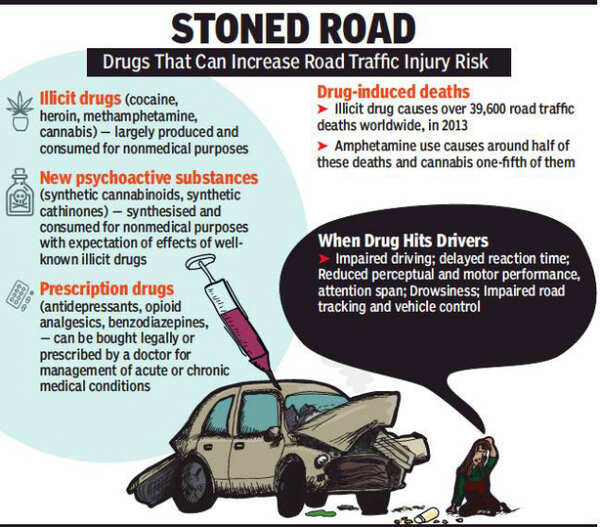
“Cannabis, LSD, MDMA or Ecstasy, hashish and cocaine are among the drugs being seized in the city.

Drugs can severely impact a user’s perceptual and motor skills, delaying reaction and information processing time, say experts. It can be a deadly problem if user is driving. Road safety experts pointed out that even legal drugs prescribed by doctors to treat common medical conditions affect the performance of the driver. “Amphetamines or stimulants used to treat hyperactivity or obesity impact a driver’s motor performance. According to the World Health Organisation, the risk of a fatal crash among those who have used amphetamines is five times higher than among non-users,” said Vinod K Kanumala, CEO of Indian Federation of Road Safety.
Till June this year, Delhi Police caught 1.5 lakh drunk drivers. Drug users, though, are a different matter. “We can detect drug-using drivers visually, or through smell. If they are caught, they can be booked under the Narcotics, Drugs and Psychotropic Substances (NDPS) Act,” said Alok Kumar, Joint Commissioner of Police (Traffic), Delhi.
Without technology, police can do very little to catch drug users during checks. “Currently, we can only seek a test of narcotics content in the system of a person if he is involved in an accident,” said Anil Kumar, Additional Commissioner of Police (Traffic), Hyderabad.
In Chandigarh, police said the mechanism for catching users on road was complicated. “We can only send blood and urine samples for testing. There is no other method,” said a Chandigarh Police officer.
The window of time to detect the drug while driving is very small, since drug gets absorbed in the bloodstream soon after consumption, officers said. The problem is not existing laws, which specify tough action against users. Additional director-general of Punjab Police Harpreet Singh Sidhu, special principal secretary to the chief minister and earlier head of the anti-drug STF, said, “A drug user can be booked under section 27 of NDPS Act, and can be imprisoned for a year.”
Punjab ADGP (traffic) Sharad Satya Chauhan said, “It might be difficult to assess if driver has taken drugs, but police can easily make out a user from his physical appearance. In addition to NDPS Sections, we can also invoke Section 279 (rash and negligent driving) of the IPC.”
In a measure which could show other states the way forward, catching drivers on drugs might become easier with Telangana’s new road safety bill, currently being drafted, said T Krishna Prasad, DGP and chairman, Road Safety Authority, Telangana. “We are now looking at when to subject someone to a drug test since it involves taking a blood sample. We are taking legal opinions on the circumstances under which we can ask somebody to cooperate in taking a sample,” added Prasad.
End of Article
FOLLOW US ON SOCIAL MEDIA






Hot Picks
TOP TRENDING
Trending Stories
In City
Entire Website
- Breathtaking cosmic catwalk! SpaceX makes history with first-ever private spacewalk
- 2 Army officers thrashed, their female friend gang-raped in Madhya Pradesh
- Bangladesh announce Test squad for India tour
- Top fastest trains in the world: From China's CR Harmony to Germany's ICE
- Amid Shannon Sharpe Viral Video, Former ESPN Host Michelle Beadle Reacts Claiming It Was Not Her
- Ayushman Bharat insurance scheme expanded to cover elderly above 70
- 'Will be demolished if... ': Himachal minister's assurance amid Shimla mosque row
- Mumbai's Haji Ali and Mahim dargahs cancel Eid shamiana
- Garena Free Fire MAX redeem codes for September 11, 2024: Win free room cards, skins, diamonds, pet skins, and more rewards today
- GK for students: Top 8 Largest Mammals in the World
- India needs to know why China disturbed peace: EAM Jaishankar
- Putin invites 'great friend' PM Modi for talks on sidelines of BRICS summit
- Why India is now insisting on an immediate ceasefire in Gaza
- 'Deal with it': Oppn vs BJP over PM Modi attending Ganpati Puja at CJI's house
- Patient, 11, raped in Agra medical college, doctor held
- In the (y)ear of conspiracy theories, Trump hears insults galore
- Pictures, videos: Why there is no other beach like this in India
- Planning to buy iPhone 16? How much Apple will give for iPhone 12 & others
- India, China to work urgently for disengagement in Ladakh
- Adani Group rejects Hindenburg claim of $310 mn asset freeze in Swiss banks

Popular Categories
Hot on the Web
Top Trends
Trending Topics
Alia BhattMalaika Arora Father DeathArbaaz KhanNatasa StankovicMr Bachchan OTT ReleaseNational Parks In IndiaSelena GomezGOAT CollectionVikas Sethi DeathMalayalam ProducersIndia's Best Dancer 4Simi GarewalDilli BabuIndian National ParksLaung BenefitsVikas SethiiPhone 16Microsoft 365 OutageCsir Ugc Net 2024Wordle Answer
Living and entertainment
Latest News
India successfully flight tests surface-to-air missileFintech Moneyview turns unicorn, 6th one this yearDigest this: Unhealthy gut may be linked to Parkinson’s diseaseCSIR UGC NET 2024 result declared: Steps to download scorecards at csirnet.nta.ac.inAadhaar card update: Do you have to compulsorily update details on your Aadhaar every 10 years?Single Indians are now choosing slow, meaningful dates over-elaborate outings, reveals an online dating platform’s surveyWho was Illia 'Golem' Yefimchyk, the Belarusian bodybuilder who consumed 2.5 kg of meat and 108 sushi pieces daily before his death at 36?Vijay Varma reveals he was DROPPED from 'Sacred Games' at the last minuteWWE Star Discusses Why Sid Vicious Deserves a Hall of Fame SpotCatching up with sports stars in DelhiSalman Khan surrounded by bodyguards as he arrives at Malaika Arora's mother's house to offer his condolences - WATCHCMF Buds Pro 2 by Nothing review: Big delivery on a budgetMallika Sherawat makes big screen comeback in Rajkummar Rao's 'Vicky Vidya Ka Woh Wala Video'; director reveals why he cast herArbaaz Khan spotted outside Malaika Arora's house along with police after the tragic news of her father's demise by alleged suicide - WATCH VIDEOHarvey Weinstein charged with additional crimes during hearing on rape chargesMitchell Schwartz's Cryptic Tweet Stirs Debate About Mahomes' ContractSiddhant Chaturvedi reveals he rejected Ranbir Kapoor, Alia Bhatt and Amitabh Bachchan starrer Brahmastra after father’s advice: 'He asked me, ‘Tujhe kaun dekhega?''EcoR unloads 100 million tons of goods in just 160 days
Copyright © 2024 Bennett, Coleman & Co. Ltd. All rights reserved. For reprint rights: Times Syndication Service